BUMPDOJO / SHAPE MATCHUPS
Six shapes.
One opponent.
A ring, a hammer, a hook, a wedge, a cross and a plus. Watch how each meets CPU X in a controlled Classic setup, then choose what to try in your next round.
One no-move recording and one skill recording per shape. Equal starting mass and maximum radius; different collision outlines and rotational inertia. These examples help you observe, not rank the shapes.
THE SAME STARTING QUESTION
What changes when you use a skill?
Each pair starts with the same player shape, CPU X and 0° aim. In the second recording, the player uses that shape’s skill once at 0.400s, before the no-move sample’s first contact. CPU X can use its own moves in both recordings. Its policy is the same; its move times can change as the scene changes.
| Shape / skill | No player moves | One player skill at 0.400s | What the skill changes |
|---|---|---|---|
| O · Anchor | CPU win · ring-out3.042s | CPU win · ring-out3.375s | Anchor brakes movement and pulls inward for 1.2 seconds. |
| T · Hammer | CPU win · ring-out3.092s | Player win · ring-out2.908s | Hammer lunges toward the opponent. |
| L · Hook | CPU win · ring-out12.492s | CPU win · ring-out2.183s | Hook pulls both tops together for 0.9 seconds while in range. |
| V · Sidestep | CPU win · ring-out1.908s | CPU win · ring-out1.158s | Sidestep adds sideways motion. |
| X · Overdrive | CPU win · ring-out6.283s | CPU win · ring-out3.342s | Overdrive adds spin, up to the shared cap. |
| + · Pulse | CPU win · ring-out4.708s | CPU win · ring-out4.992s | Pulse pushes both tops apart when they are in range. |
T wins its skill sample here. That does not establish T as the strongest shape. The other results do not establish that their skills are useless. These 12 deterministic recordings are not a win-rate sample or human playtests; CPU reactions and later contacts are part of each trajectory.
LOOK CLOSER
Pause at the moment you want.
Choose a shape and input. The overhead diagram shows saved positions, rotations and the safe ring. It does not run a new match. The actual perspective arena is shown in the case screenshots below.
RECORDED STATES / OVERHEAD VIEW
GREEN = PLAYER · CORAL = CPU X
The six tables below are available while the replay loads.
Player and CPU move markers appear here.
Move budgets and contact count are shown with each saved state.
Loading the recorded states. The tables and screenshots below remain available.
Keyboard: Tab to a control. Use arrow keys to choose a shape or input. On the slider, arrows step through saved frames; Home and End reach the first and last frame. Moving the slider or changing a selection pauses playback. At 0.400s, adjacent frames show before and after the player skill. Leaving this tab pauses playback.
01 / THE RING
O · Anchor
An open center and a continuous outer edge. Anchor brakes movement and pulls inward for 1.2 seconds.
Both O recordings first touch at 0.492s. The Anchor sample ends at 3.375s, compared with 3.042s without player moves; both end with a CPU ring-out win. Watch the position after the skill rather than treating a longer round as a win.
| Player input | First contact | Result / end |
|---|---|---|
| No player moves | 0.492s | CPU win · ring-out3.042s |
| Anchor at 0.400s | 0.492s | CPU win · ring-out3.375s |
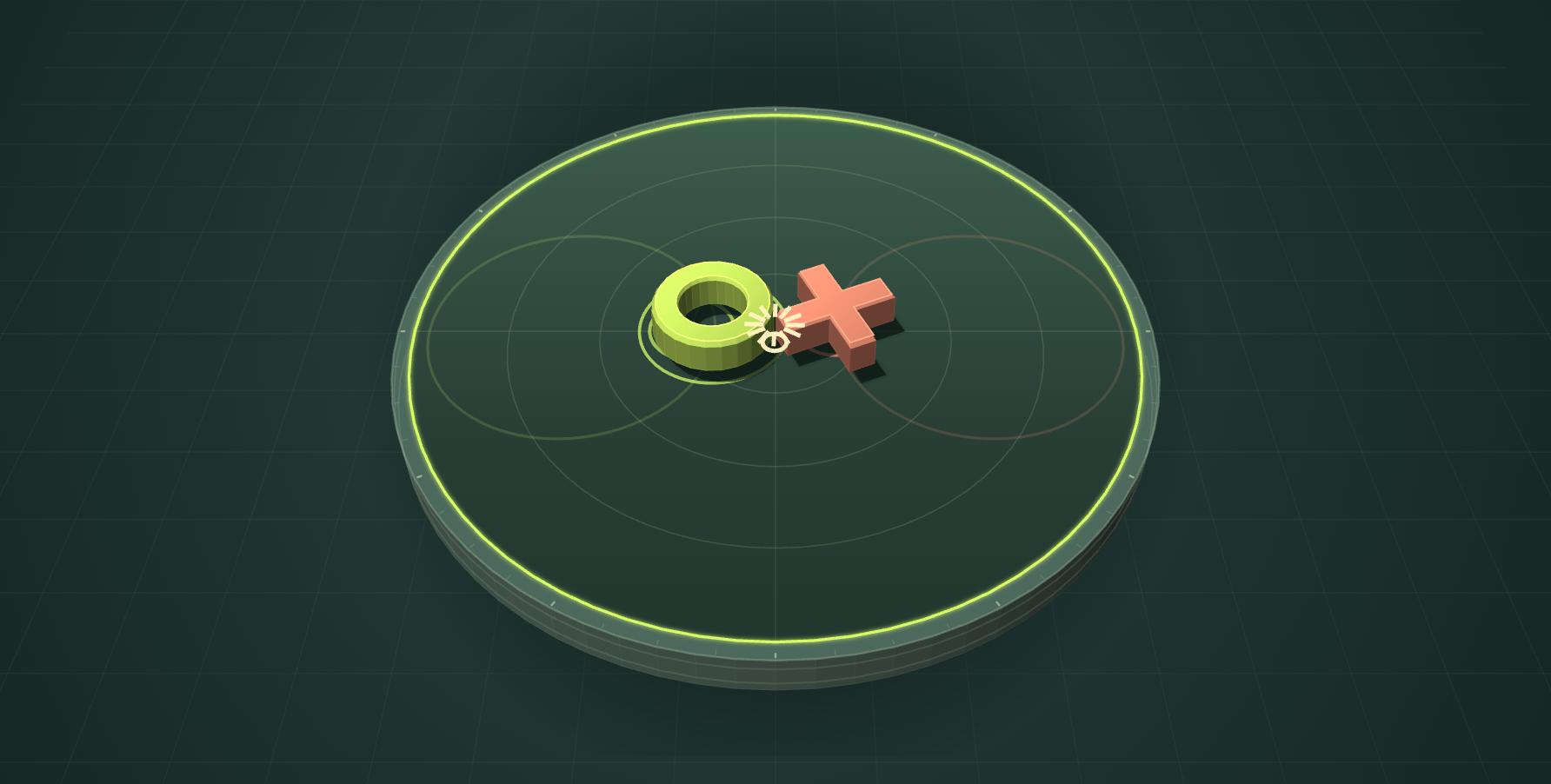
Next round: Try Anchor once before contact, then try saving it until you are moving outward. Watch where O’s center is relative to the safe ring.
Open the arena → manually choose O, CPU X and 0°02 / THE HAMMER
T · Hammer
A wide crossbar and a narrow stem. Hammer lunges toward the opponent.
First contact is 0.500s with Hammer and 0.533s without player moves. The player wins the Hammer sample at 2.908s; the CPU wins the no-move sample at 3.092s. This particular reversal is an observation, not evidence that T is the strongest shape.
| Player input | First contact | Result / end |
|---|---|---|
| No player moves | 0.533s | CPU win · ring-out3.092s |
| Hammer at 0.400s | 0.500s | Player win · ring-out2.908s |
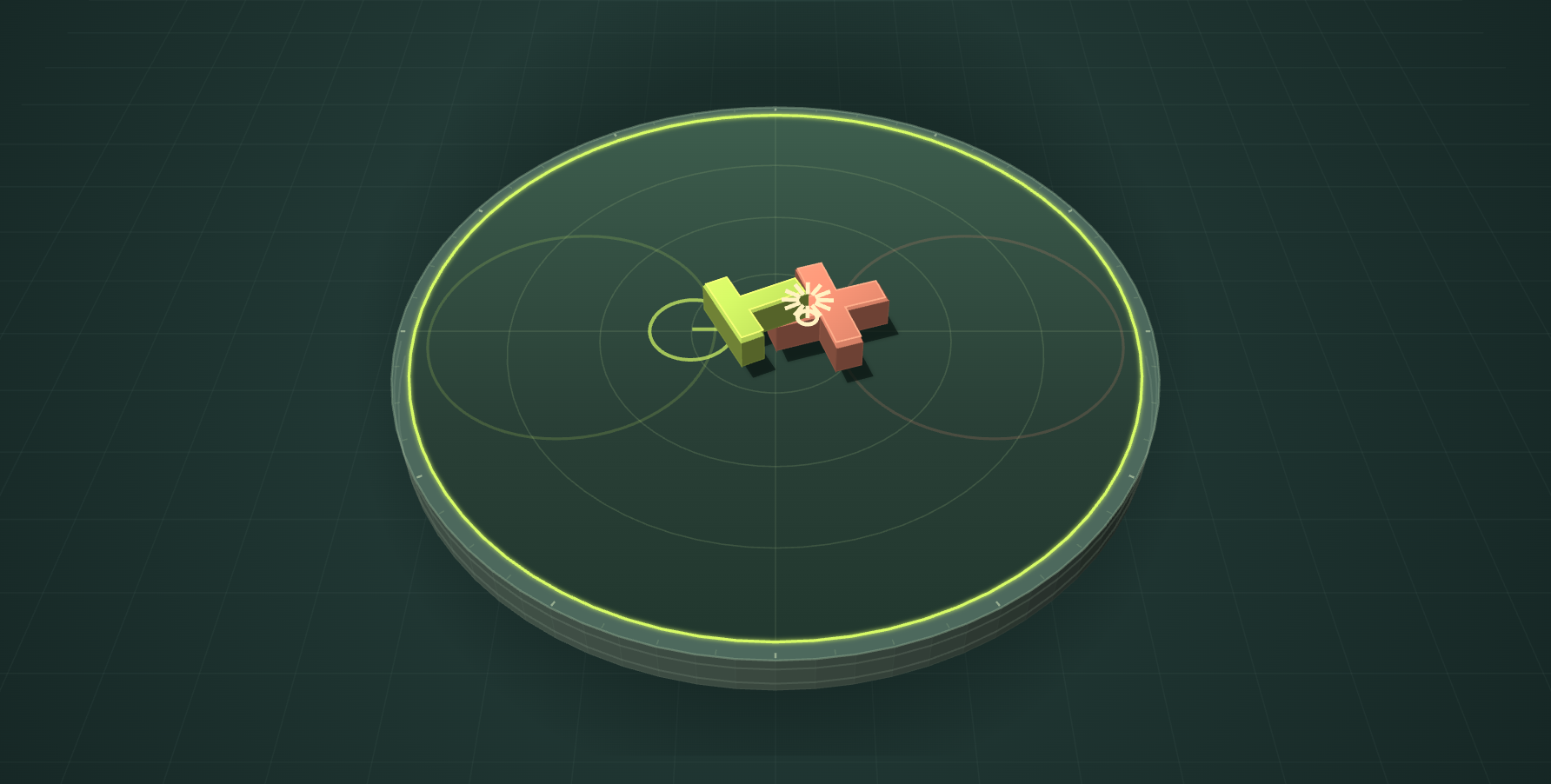
Next round: Try one early Hammer, then a later one. Watch which edge faces X at contact and where each top travels afterward.
Open the arena → manually choose T, CPU X and 0°03 / THE HOOK
L · Hook
An open corner formed by two unequal arms. Hook pulls both tops together for 0.9 seconds while in range.
Both L samples first touch at 0.508s. The no-move recording lasts 12.492s; the Hook sample ends at 2.183s. Both are CPU ring-out wins. More time in the arena does not establish a better strategy.
| Player input | First contact | Result / end |
|---|---|---|
| No player moves | 0.508s | CPU win · ring-out12.492s |
| Hook at 0.400s | 0.508s | CPU win · ring-out2.183s |
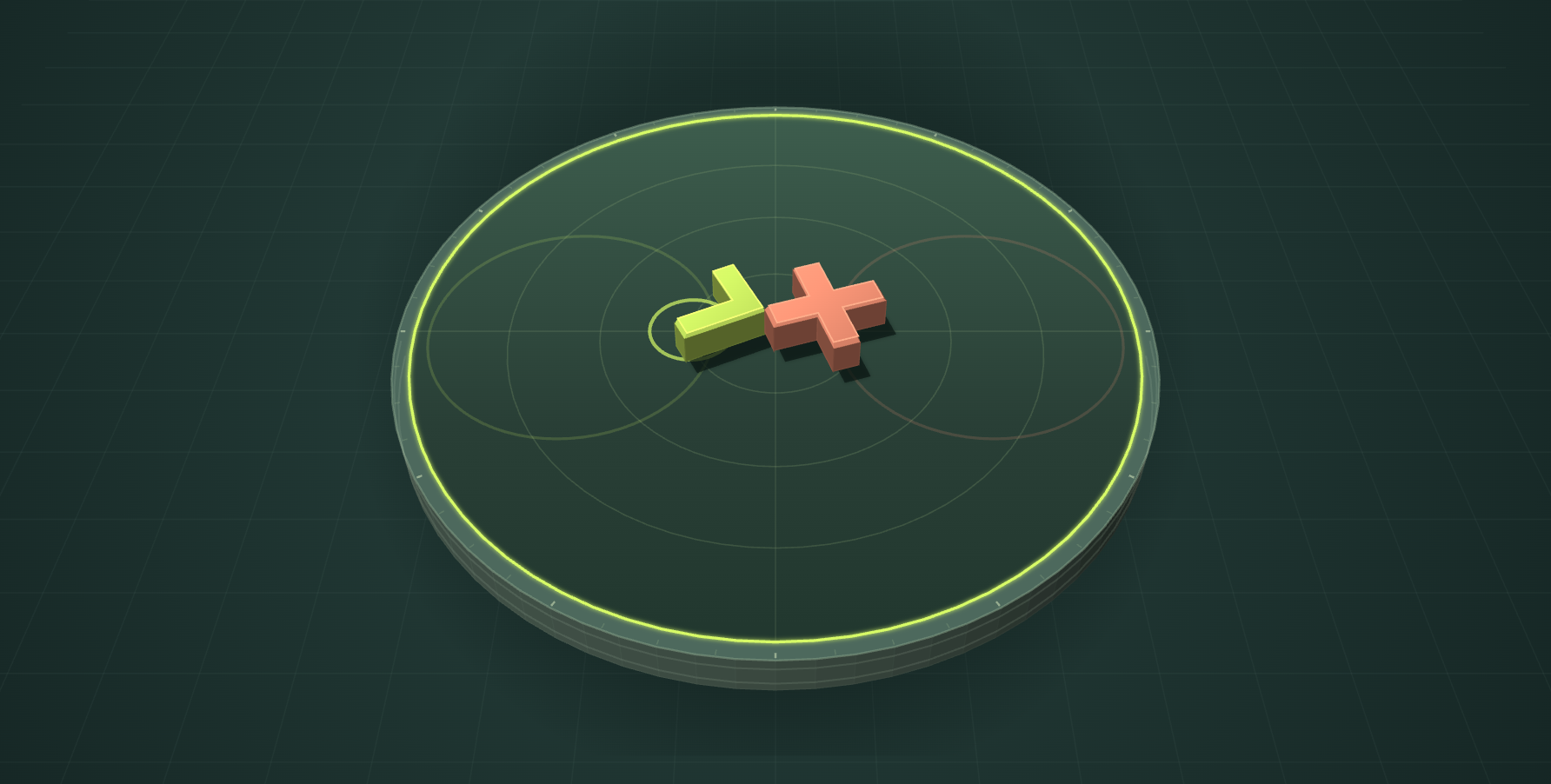
Next round: Try Hook once while the tops are close, then save it for another approach. Watch both trajectories during the pull.
Open the arena → manually choose L, CPU X and 0°04 / THE WEDGE
V · Sidestep
Two angled arms with space between them. Sidestep adds sideways motion.
First contact is 0.525s without player moves and 0.533s after Sidestep. Both end with CPU ring-out wins: 1.908s and 1.158s respectively. A small contact-time change can accompany a very different path.
| Player input | First contact | Result / end |
|---|---|---|
| No player moves | 0.525s | CPU win · ring-out1.908s |
| Sidestep at 0.400s | 0.533s | CPU win · ring-out1.158s |
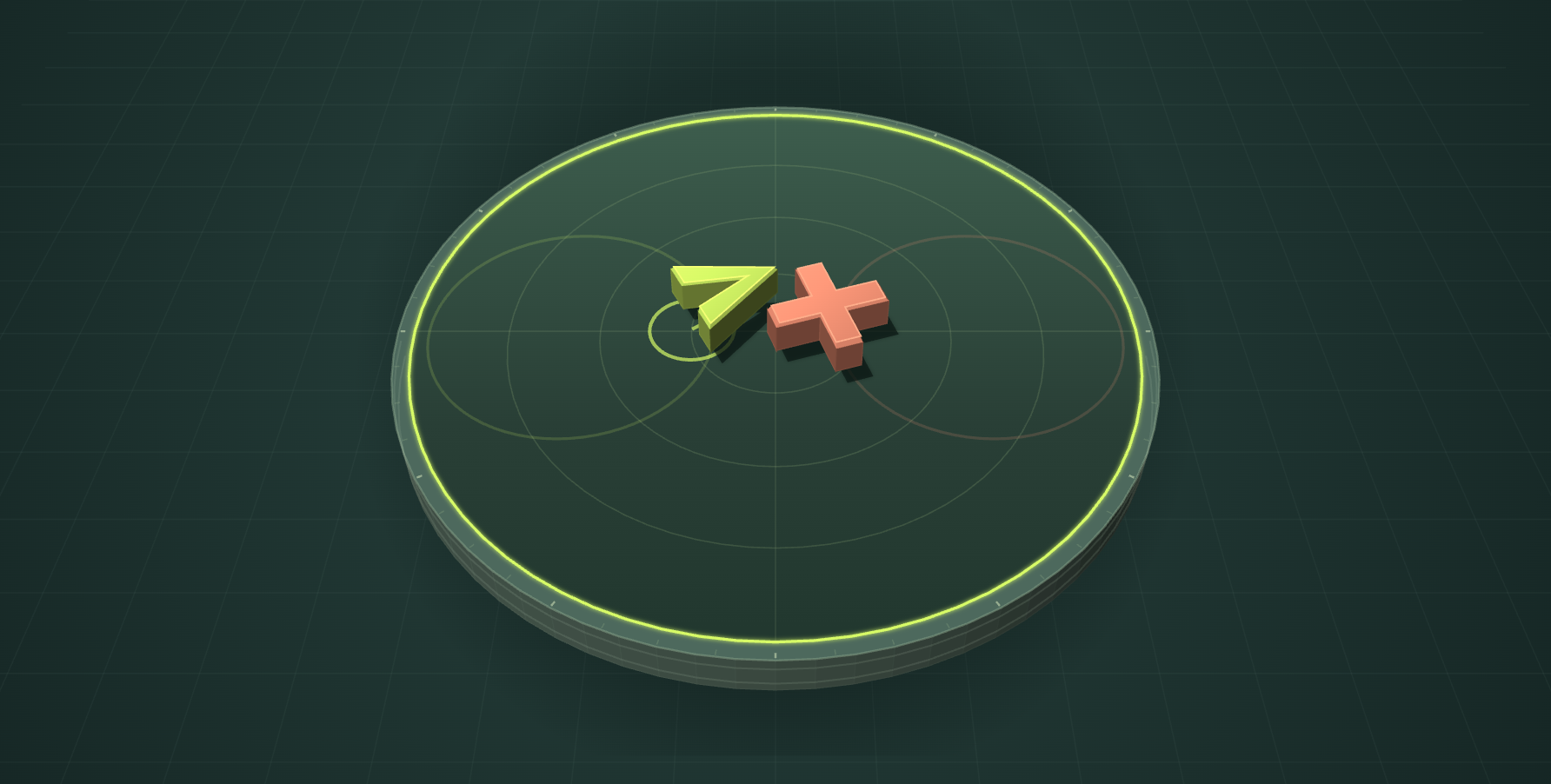
Next round: Try Sidestep before an approach, then wait until the next contact. Watch the direction of travel and the safe boundary, not just the gap between the arms.
Open the arena → manually choose V, CPU X and 0°05 / THE CROSS
X · Overdrive
Four diagonal arms around a solid center. Overdrive adds spin, up to the shared cap.
The no-move X mirror match first touches at 0.492s and ends at 6.283s. With player Overdrive at 0.400s, contact is at 0.517s and the round ends at 3.342s. Both are CPU ring-out wins; extra spin does not guarantee staying inside.
| Player input | First contact | Result / end |
|---|---|---|
| No player moves | 0.492s | CPU win · ring-out6.283s |
| Overdrive at 0.400s | 0.517s | CPU win · ring-out3.342s |
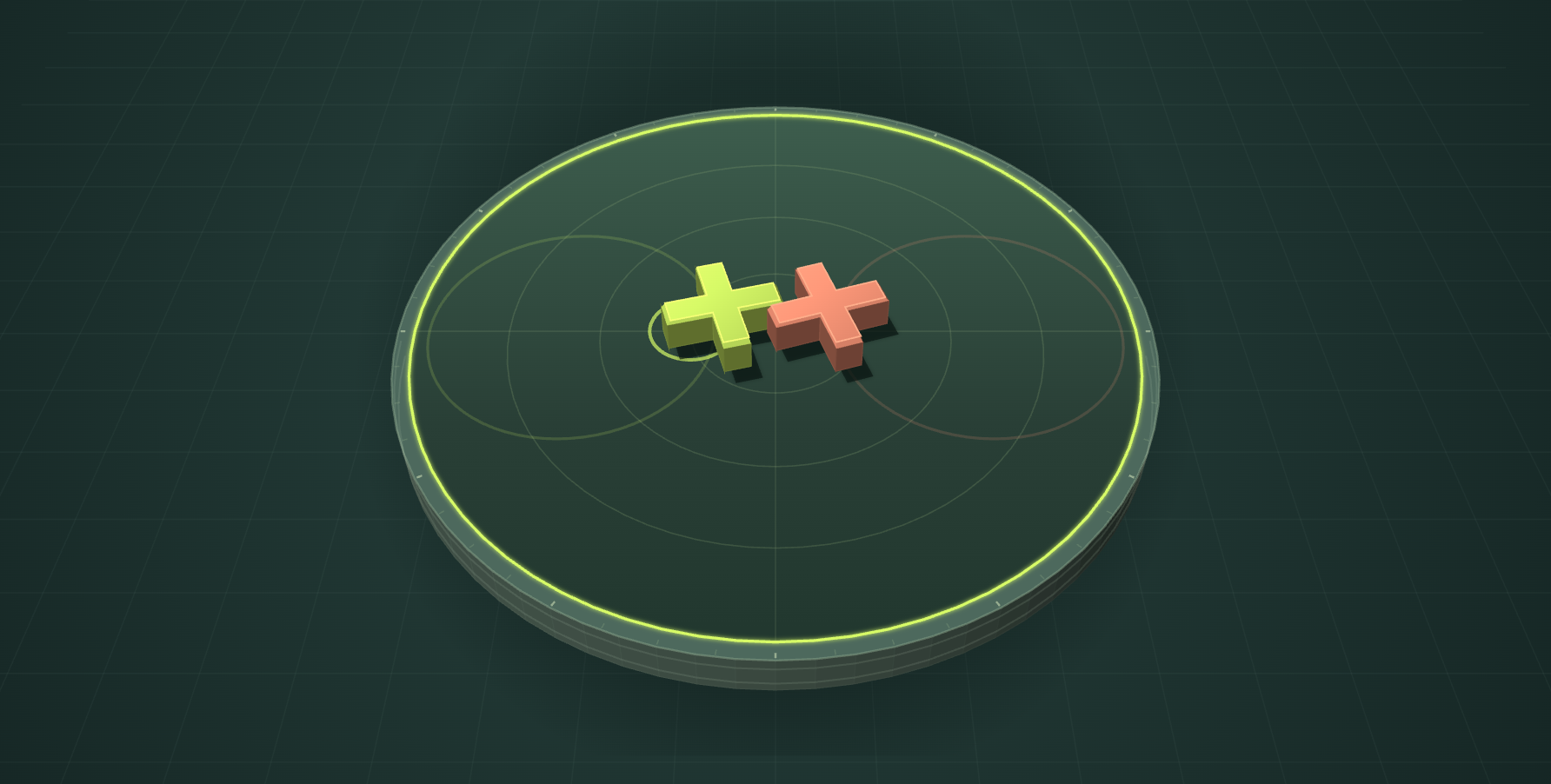
Next round: Try Overdrive once, then watch position as well as spin. In another round, keep it until spin has fallen; choose your own timing.
Open the arena → manually choose X, CPU X and 0°06 / THE PLUS
+ · Pulse
Four straight arms around a solid center. Pulse pushes both tops apart when they are in range.
The first contact moves from 0.525s without player moves to 1.017s with Pulse. Both samples end with CPU ring-out wins, at 4.708s and 4.992s. The later contact is visible here; it is not a general promise of safety.
| Player input | First contact | Result / end |
|---|---|---|
| No player moves | 0.525s | CPU win · ring-out4.708s |
| Pulse at 0.400s | 1.017s | CPU win · ring-out4.992s |
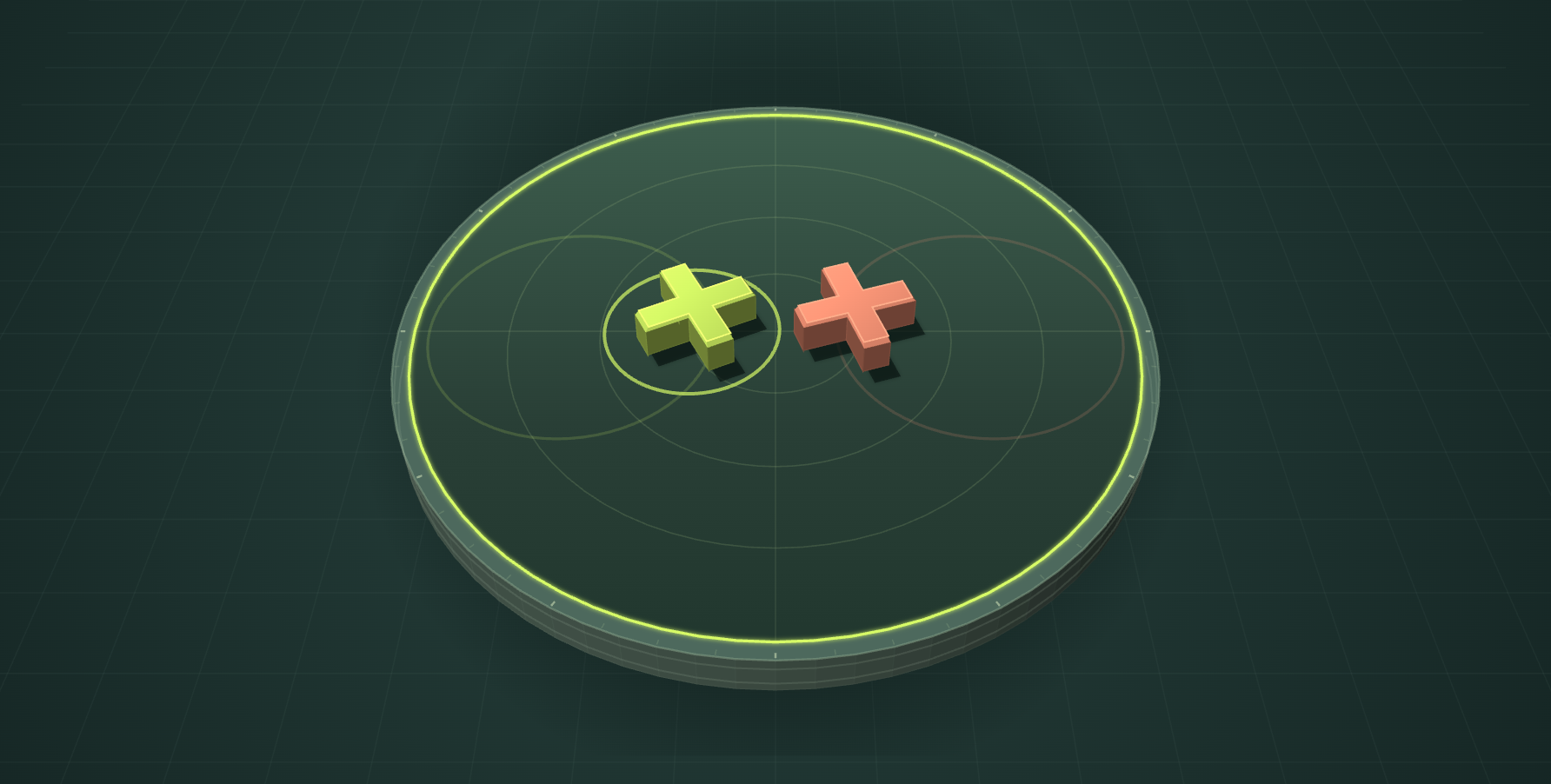
Next round: Try Pulse once on an approach, then try it closer to the boundary. Watch the space it creates for both tops.
Open the arena → manually choose +, CPU X and 0°YOUR NEXT ROUND
Pick one thing
to watch.
Start with one shape, then repeat with a different moment for its skill. Look at the path, the contact edge and the safe boundary. A match in the arena is yours to play.
For examples focused on when to act, see the dash and skill timing guide →.
Set it up yourself
- Open the arena and choose your player shape.
- Set the computer opponent to X and the aim to 0°.
- Press Launch battle. Choose when to use your moves.
SPACE launches when ready and dashes during a round. E uses your shape’s skill. On touch, use the Launch, Dash inward and skill buttons. These links open the arena; they do not choose a shape or launch for you.
Open the Classic arena ↗Read the examples fairly.
What is controlled, and what can change?
These are 12 automated state recordings captured from the public Classic game on 24 October 2026. Each shape has two recordings: no player moves, or one accepted player skill at 0.400s. Neither uses a player dash. Every recording starts at 0° against CPU X, with the same starting mass, maximum radius and spin magnitude.
The common skill time was chosen before the first no-move contact for every shape, not by searching for a winner. The CPU follows the existing deterministic trigger policy described in the full rules. Because it responds to the scene, its action times may differ between samples. These are not fixed CPU scripts or isolated tests of geometry alone.
The replay reads saved states from this site. It includes the input-before and input-after states and displays no invented frames. Times in the text and tables are rounded to three decimal places. The screenshots are unedited exports of the actual Classic game canvas at 0.500s in each skill sample.
What can’t these samples tell me?
They do not establish win rates, a best shape, the best timing, or how much human players enjoy the game. A win here is one result under these settings. The game uses experimental 2D arcade physics shown from a 3D perspective; these examples do not establish physical accuracy.
All six shapes have equal mass and normalized maximum radius. Their geometry changes rotational inertia. O has a hollow center; L’s silhouette is not evidence of an offset physical center of mass. Collision geometry is centered by the game. Different aim, timing or opponents can lead to different rounds.
Privacy & optional analytics
This page has no accounts or match uploads. Replays load static records from this site. Optional Google Analytics loads only on bumpdojo.com after you accept, with a choice lasting up to 30 days. This page measures its canonical page visit; it adds no replay, shape or practice events. Query strings, fragments and recorded state are not sent in the page location. Do Not Track and Global Privacy Control keep analytics off. Local and offline builds send no analytics. Cloudflare may process request information to deliver the site.
Analytics is off in local/offline builds.